

CPOMS and Medical Tracker now integrate. A true game changer for student safeguarding.
Discussions about integrating CPOMS and Medical Tracker began at the start of 2026. Medical Tracker had surpassed 3,000 schools across the UK, and the 100th Multi-Academy Trust had just subscribed.
CPOMS has maintained its position as the sole leader in safeguarding software for UK schools, with almost 18,000 schools relying on its solution for end-to-end safeguarding support, analysis, and intervention.
Fast forward to the end of the 2026 academic year, and the sector-first integration between the two largest health and safeguarding tools in the UK is live. Hundreds of schools have turned on integration, with ~3,000 medical incidents logged in Medical Tracker and sent straight to CPOMS. One integration, zero duplication.
Why is everyone focused on September?
This integration has come at the perfect time for schools and Trusts. As I write this, the sector and all educational contexts within it, in England, are facing a turbulent approach to the 2026/27 academic year.
The release of the Government’s white paper, “Every Child Achieving and Thriving”, and the ratification of Benedict’s Law mean September 2026 is a September like few others.
A white paper, a law and two platforms walk into a bar…
The Medical Tracker integration with CPOMs is specifically related to the government white paper.
A thorough read of the paper reveals key categories that the government have paid attention to relating specifically to Medical Tracker, CPOMS and health and safeguarding:
-
A long-standing frustration with data fragmentation.
-
An ambition to have data running through the spine of schools and Trusts.
-
Interoperability.
-
Attendance.
So, how do these categories relate to the new integration?
Data fragmentation
On data fragmentation, the white paper states, "Currently, information about children's needs is often fragmented across multiple systems, making it harder to keep records accurate and up to date. This can lead to delays in support and gaps during key transitions."
"We want data to flow seamlessly, not be locked within individual systems, so insights can be put directly into the hands of teachers, leaders and parents."
In its purpose, the integration is now a policy-aligned response from the two leading health and well-being platforms in the UK.
In its design, the integration is simple: a single checkbox at the bottom of every new incident form in Medical Tracker. If a medical incident is deemed noteworthy, of interest, or critical to a safeguarding lead, it is sent immediately and appears in CPOMS.
In its purpose, the integration is now a policy-aligned response from the two leading health and well-being platforms in the UK.
Implementing a data spine
On its ambitions for a data spine, the white paper states, "We will develop a new 'data spine' that will create a secure, privacy-respecting and streamlined way to connect and share information across different systems in education."
Well, however the government plans to do that, the vendor sector is ahead of the curve. Medical Tracker and CPOMS have built the kind of connected infrastructure the government is only now beginning to mandate.
Almost 500 schools and Trusts that piloted the integration were unequivocal in their praise for the data transference. Medical Tracker allows teams to record granular details on medication administrations, intimate care, and locations – all highly customisable for the school. Having this granularity mirrored in CPOMS then elevates the investigations done by safeguarding teams to identify, flag or intervene.
Interoperability
On joined-up systems, "Our ambition to rebuild services for children and families comes in two parts: first, to make services available and accessible to families and, second, to join up those services so that information can be shared between them to give children and young people consistent support that fits around their needs."
"We must move from services operating in isolation, each with their own performance indicators and funding priorities, to services for children and families working together across a local system, jointly responsible for outcomes."
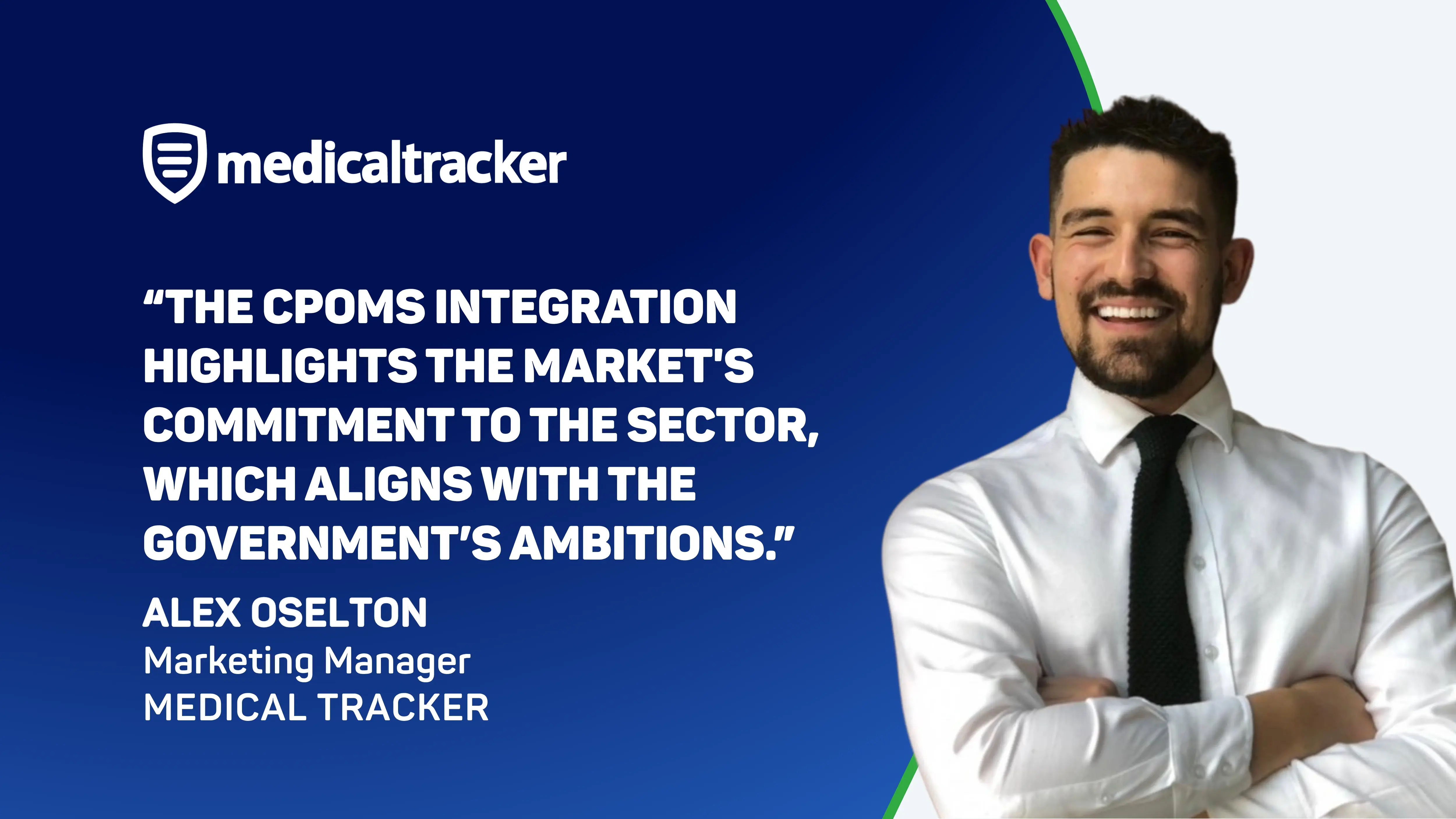
This new integration highlights the market's commitment to the sector, which aligns with the government’s ambitions.
This new integration highlights the market's commitment to the sector, which aligns with the government’s ambitions. Traditionally, siloed operations for individual gain may have been symptomatic of the private sector, but the boundaries between what is right for the pupil/school and what is right for the organisation are merging, and we are happy to be spearheading this with CPOMS for safeguarding.
Attendance
The white paper states, “Children's mental health is also a significant barrier to school attendance. By coordinating services across schools and the NHS, we're expanding Mental Health Support Teams."
In its purpose, this new integration makes sure no child falls through the gaps. Whether it is an innocuous fall in the playground this week or an inexplicable injury the next, no medical incident will remain a safeguarding gap.
With 1 in 5 children persistently absent and children's mental health named as a significant barrier to attendance, the case for joined-up medical and safeguarding records has never been stronger.
With a medical incident logged every 4 seconds on Medical Tracker and over 1.2 million medication administrations recorded in 2024/25, the volume of health data passing through schools every day is significant. The scale of medical and safeguarding touchpoints between students and schools, every day, is no longer a mystery; it’s the final piece of the puzzle made accessible.
The future
The government are unambiguous in their aims. This is perhaps best demonstrated by their goal: "We want data to flow seamlessly, not be locked within individual systems."
The integration between Medical Tracker and CPOMS is this sentence. One integration. Zero duplication.
We’re proud to introduce this integration into educational contexts and look forward to seeing and hearing about tangible improvements in pupil health and wellbeing.

Alex Oselton
Marketing Director at Medical Tracker
Alex Oselton, DipM ACIM, is a marketing leader with over eight years of experience in the global Edtech industry. Throughout his career, he's worked closely with education leaders, schools, councils and local authorities and is passionate about supporting innovation in education.